

- Sub Menu
A Walrus Needs Walruses: What Comes Next a Pacific Walrus Calf Orphaned in 2026 October 22, 2026
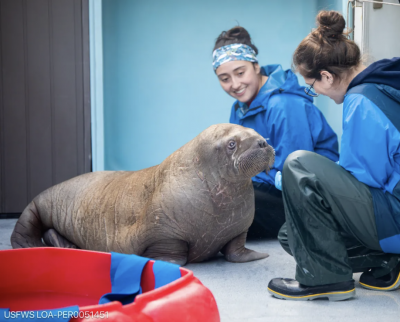
A Walrus Needs Walruses: What Comes Next a Pacific Walrus Calf Orphaned in 2026
For a better reading experience and more imagery, read this story on the ASLC blog!
For many Wildlife Response patients at the ASLC, getting healthy means getting closer to returning to the wild. For an orphaned walrus calf, successful rehabilitation looks a little different.
The ASLC is the only institution authorized to respond to stranded and orphaned marine mammals in the state of Alaska, and to our knowledge, one of the only organizations in the world to rehabilitate orphaned Pacific walrus calves. This calf is only the 12th Pacific walrus calf admitted to the ASLC in our history.
Estimated to be about five months old, this calf was found alone in northern Alaska at an age when he would normally still rely heavily on his mom. Walrus calves typically remain with their mothers for one to two years, and caring for an orphaned calf requires intensive, hands-on support from human caregivers. Because of that extended maternal dependence and the close human contact necessary for rehabilitation, the USFWS generally considers orphaned walrus calves non-releasable.
So, if returning to the wild is not an option, what does a successful future look like for this calf?
It comes down to something pretty simple: a walrus needs walruses.
During his time at the ASLC, caregivers provided around the clock feeding support, physical contact, social interaction, enrichment and veterinary care.
But, there are some things even the most dedicated human caregivers cannot provide. At the ASLC, we can provide specialized rehabilitation, but we cannot give him the opportunity to live with other walruses. Our facilities are designed to provide specialized, critical care during wildlife rehabilitation and long term care for the resident species that currently call the ASLC home (like seals and Steller sea lions).
Only a small number of facilities in the United States care for Pacific walruses (four total), so the question wasn’t simply where he could go. It was where this individual calf would have the best opportunity to thrive.
After careful planning with walrus care experts from around the country and the USFWS, SeaWorld Orlando was selected as the best long term home for this young orphaned calf!
Why SeaWorld Orlando, and why was moving him now the right decision? Keep reading for a closer look at how his health, social needs and the walruses waiting for him helped guide this important decision.
Strong from the Start
When this calf arrived at the ASLC, he was already older and in better condition than many orphaned walrus calves we have cared for.
At approximately 200 pounds, he was strong and in good body condition when first admitted to the ASLC as an orphaned calf who likely wouldn’t survive in the wild without his mother. He was dehydrated and had several superficial wounds that required treatment, but our Veterinary team approached his condition with cautious optimism.
In the weeks that followed, he remained active, ate well and grew quickly, eventually gaining 20 pounds!
Providing that initial care was a collaborative effort. Experienced animal care professionals from organizations around the country, including Georgia Aquarium, Indianapolis Zoo, SeaWorld San Diego, and SeaWorld Orlando traveled to Alaska to work alongside ASLC staff and help provide the specialized care an orphaned calf requires.
Finding the Right Social Environment
The ASLC worked closely with a group of walrus care professionals from around the country to evaluate potential long term homes, with the calf’s individual needs guiding the process. Throughout that process, the ASLC also worked closely with USFWS to coordinate his transition and ensure all necessary requirements were met. For an animal this young and social, the walruses already living at each facility matter. So do their ages, individual personalities, experience with calves and the potential social dynamics within the group.
When considering the needs of this specific calf, one home quickly stood out that had both younger walruses and a potential mother figure: SeaWorld Orlando.
Meet This Calf’s Future Herd
There will be more than one Walrus with Alaska roots waiting to greet Annautaq in Orlando!


Ukiaq, or Uki, came through the ASLC Wildlife Response Program as an orphaned calf in 2024 and after weeks, she now lives at SeaWorld Orlando. She is thriving within the herd, has formed a close bond with Kaboodle and enjoys snow, ice and enrichment activities.
For this calf, having another young walrus in Orlando was an important part of considering the potential social dynamic. Uki had a beginning remarkably similar to his own, and now he will have the opportunity to grow up with another walrus closer to his age.
Kaboodle is a 23 year old adult female Pacific walrus who is an experienced mother and proven surrogate mother figure to orphaned calves, including Uki. Her nurturing experience will play an important role as Annautaq is gradually introduced.
Pictured here is Kaboodle with her own calf born at Seaworld Orlando in 2019, Kora Kora now lives at SeaWorld San Diego.
Garfield is a 44 adult male Pacific walrus who was rescued as an orphaned male calf in Alaska and hand-raised at SeaWorld Orlando (before the ASLC existed!. He is a living example of what a rescued walrus can become. He participates voluntarily in his daily health care, including personalized geriatric care and physical therapy routine.
Of course, we cannot decide what those relationships will look like for him.
Walruses have individual personalities and preferences, and introductions will be carefully managed by his new caregivers. He will ultimately decide who he gravitates toward and how he fits into the group, and will ne supported by animal care and veterinary professionals with extensive experience caring for the species.
A Big Move Behind the Scenes
We value being transparent with our followers, and are happy to share that this calf left Alaska on October 1, 2026. For our small team, the days surrounding his departure had to be focused first and foremost on the calf and the logistics of safely moving him and a team of veterinarians and caregivers nearly 4,000 miles to his new home. A move of this scale required all hands on deck and careful coordination among our and our partner’s Veterinary, Animal Care, and Communications teams, along with permitting agencies and airlines.

Now that he has safely completed that journey, we’re excited to have time to share more about the work that went into his move!
Preparations for travel became part of his daily routine. He was introduced to his transport unit with regular bottle feeds, giving him time to become comfortable with the space before travel day.
Animal care and veterinary staff from SeaWorld Orlando had already traveled to Alaska to work alongside our team, giving his future caregivers time to learn his routines before the move. One of the ASLC senior wildlife response specialists also traveled to Orlando so a familiar face would be there when he arrived!
The transport went very smoothly, with dedicated teams from the ASLC and SeaWorld Orlando coordinating his departure and arrival. This calf did remarkably well throughout the process! Now that he is home, and after a quarantine period to protect the other walrus from potential diseases, he will slowly start to be introduced to the other walruses!

Annautaq takes a bottle from one of his new caretakers after arriving in Orlando. ASLC Wildlife Response Specialist Savanna (left) traveled to Orlando to greet the calf when he arrived and assisted with the first few days of care.
We are passing the incredible care you’ve seen us share these past two weeks to another trusted organization that can give this walrus calf what he needs longterm.
Here in Alaska, our work continues. We will be here, ready for the next animal that needs help, with the people, expertise and partnerships in place to answer that call!
Make sure to follow the Alaska SeaLife Center and SeaWorld Orlando on social media! Both organizations will be sharing insight on how care is given to this special calf.