

- Sub Menu
Remote Alaska Community, Walrus Biologists, and Wildlife Response Team Come Together to Rescue Orphaned Pacific Walrus Calf October 6, 2026
Remote Alaska Community, Walrus Biologists, and Wildlife Response Team Come Together to Rescue Orphaned Pacific Walrus Calf
Read this story with more imagery on the ASLC blog!
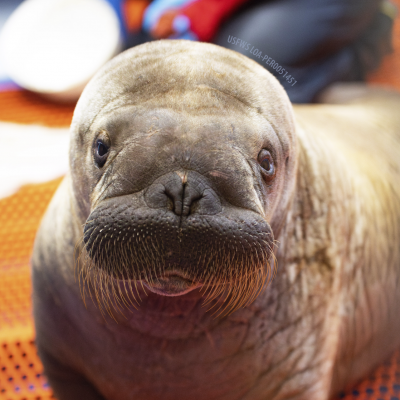
An orphaned male Pacific walrus calf arrived at the Alaska SeaLife Center on September 14, 2026, following a remarkable rescue from the region around Point Lay, Alaska, that brought together communities, researchers, and wildlife response partners across the state. Orphaned Pacific walrus calves are among the rarest and most specialized patients in marine mammal rehabilitation. Since opening in 1998, the ASLC has cared for only 12 orphaned Pacific walrus calves, and is one of the few organizations known to have rehabilitated orphaned Pacific walrus calves.
This male calf was found alone on a remote beach in the region of Point Lay, Alaska by U.S. Geological Survey (USGS) research walrus biologist Tony Fischbach and Ilisa?vik student Violet Anniskett, who is also from Point Lay. Fischbach is a walrus biologist who is part of a long-term study monitoring the Pacific walrus. The project uses survey drones, satellite imagery and other methods to collect a range of data about Pacific walruses to support the requirements of the Marine Mammal Protection Act.
Walruses seasonally form dense aggregations at coastal haulouts, where they are very sensitive to both human-caused and natural disturbances. When disturbed, they often stampede into the water, which can result in injuries and mortalities for some animals from trampling. When they first discovered the calf, Anniskett and Fischbach were surveying the beach after a walrus herd had left the area due to heavy surf during a storm. The researchers were collecting samples from fresh walrus carcasses to test for harmful algal toxins, which will help researchers better understand baseline toxin levels in walruses. During this work, they were surprised to find an orphaned calf hidden between older remains of two adult walrus carcasses, something Fischbach had not previously encountered during more than ten years of working with walrus herds at this site.
Walruses have long held important cultural and subsistence significance for Alaska Native communities in the region, and eligible Alaska Native residents may legally harvest walruses for subsistence purposes. The Native Village of Point Lay and community members supported rehabilitation for this calf and played an important role in coordinating his transportation. Generations of local knowledge about Pacific walruses, along with years of scientific expertise from researchers and wildlife response experts, made this complex response possible.
After approval was received from the U.S. Fish and Wildlife Service (USFWS) and the local Inupiaq community to rehabilitate the orphaned walrus calf, immediate coordination started to get the calf more than 800 miles to the only marine mammal rehabilitation center in the state of Alaska: the Alaska SeaLife Center in Seward, Alaska.
Transportation could not immediately reach this remote location for the calf. Storm conditions left Anniskett and Fischbach isolated on the island. They needed to shepherd the orphan more than half a mile along the island to an abandoned building where the calf could be safe from predators while they waited for transportation.
“When we found him, a determined flock of gulls was intent on scavenging him. He was in immediate peril of suffering this fate had we not gotten approval to intervene. Two polar bears were also active on the island,” said USGS Wildlife Biologist Tony Fischbach.
The two researchers stayed with the calf for nearly three days. Once transportation became possible, and with the aid of Point Lay community members and researchers, the calf was transported to the community airport. There, they were met by a plane and two ASLC Wildlife Response staff members, who escorted the calf by air and van for the long journey to Seward, Alaska.
The calf arrived safely at the ASLC late on the evening of September 14, 2026. The ASLC team approached his initial veterinary admit exam with cautious optimism. Weighing about 200 pounds and estimated to be 5 months old, he was alert, responsive and in good body condition, though dehydrated. He also had several superficial wounds, which were treated with anti-inflammatory medication and antibiotics. After administering subcutaneous fluids and other stabilizing treatments, the team prepared for the intensive care ahead.
The care regimen for orphaned Pacific walruses in rehabilitation is more demanding and hands-on than for many other marine mammals. The mother and calf bond of the Pacific walrus is known as one of the longest and strongest among pinnipeds, with calves typically remaining with their mothers for one to two years. As highly social animals, close physical contact with their mother and other walruses is an important part of a calf’s early life. When a calf is orphaned, human caregivers can serve as surrogates under the direction of authorized wildlife response and veterinary professionals, remaining with the calf around the clock to provide physical contact, social interaction, feeding support and veterinary care as needed. This type of intervention requires specialized expertise and should only take place as part of an authorized response.
While remembering the three days that researchers Anniskett and Fischbach cared for the orphaned calf, Anniskett said, “He bonded with us fast and wouldn’t sleep unless one of us were in the room. It was just us two for three days, stuck in a storm with the young walrus.”
This level of care continued throughout the calf’s time at the ASLC. “Caring for an orphaned walrus calf is truly a team effort and requires around the clock commitment,” said ASLC Wildlife Response Curator Jane Belovarac. “At least two staff members have been working shifts around the clock to stay with him and provide the care he needs. This means long days and some unusual sleeping schedules for our team, but this is why we do this work. Our focus is on giving every animal in our care the support they need for the best possible outcome.”
The level of hands-on care is essential for the calf’s immediate well-being, but it also means he becomes accustomed to close human contact. Because of this habituation to people, the calf will not be a candidate for release back to the wild. According to the USFWS, “the majority of walruses typically strand as calves and are not good release candidates due to the extended period of maternal dependency. USFWS generally considers walrus calves to be ‘non-releasable’ and considers all stranded walrus on a case-by-case basis for permanent placement.” This differs from many patients admitted to the ASLC Wildlife Response Program, where successful rehabilitation and release back to the ocean are always the primary goal.
This calf is older and appears stronger and in better health than the typical orphaned walrus patients admitted to the ASLC, allowing the team to quickly look ahead to another very important part of his care: his social needs.
The ASLC worked closely with a group of walrus care professionals from around the country to evaluate potential long term homes, with the calf’s individual needs guiding the process. Throughout that process, the ASLC also worked closely with USFWS to coordinate his transition and ensure all necessary requirements were met. Once at his new home, he will serve as an ambassador for his species, helping people better understand Pacific walruses, the changing marine environments they depend on, and the species’ strong connection to Alaska’s people.
Within the past few days, the calf transitioned from the Alaska SeaLife Center to his long term home after reaching stable health and no longer requiring critical rehabilitative care at the ASLC. The ASLC will announce the facility and share more about this next chapter in the coming days.
The Alaska SeaLife Center’s Wildlife Response Program depends on partnerships around the state and the collective support of donors, sponsors and community members to respond to stranded and injured marine animals like this orphaned calf. Supporters can learn more and contribute to ASLC’s mission work at www.alaskasealife.org/donate.
The Center acknowledges the ongoing generous support of the Wildlife Response Program from supporters such as ConocoPhillips Alaska, Partners 4 Wildlife, Alaska Collection, Stanley J Williams Fund, The Theresa Bannister Fund, M.E. Webber Foundation, and Mike Coffing.